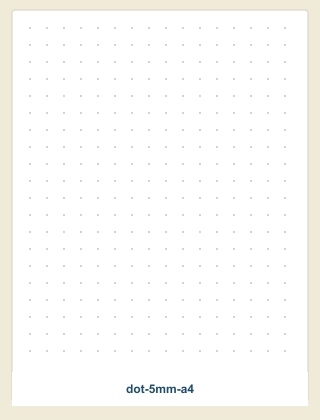
5mm Dot Grid — Bullet Journal
5mm spaced dots on A4 with light gray. The standard layout for bullet journals and planners. Clean and minimal.
Dot grid paper replaces solid rules with a faint matrix of dots, so you get just enough structure to keep writing and drawing straight without the clutter of full lines. This free printable dot grid paper generator lets you set the dot spacing, size, and colour, preview it live, and download a dot grid paper PDF at A4, A5, or Letter — no signup and no watermark.
✓ Real-time preview — every change updates instantly.
For evenly spaced dots, choose “Actual Size” (not “Fit to Page”) in your printer dialog.
One-click download of ready-made dot grid paper — or open any template in the generator above to tweak it.
5mm spaced dots on A4 with light gray. The standard layout for bullet journals and planners. Clean and minimal.
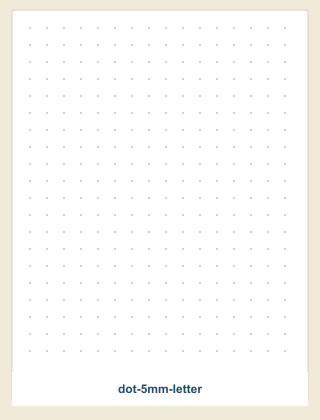
5mm dot grid on US Letter paper. Perfect for note-taking and journaling in North American standard size.
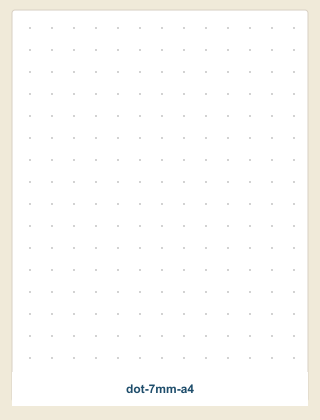
Wider 7mm dot spacing on A4. Great for sketching ideas, mind maps, and freeform drawing with more open space.
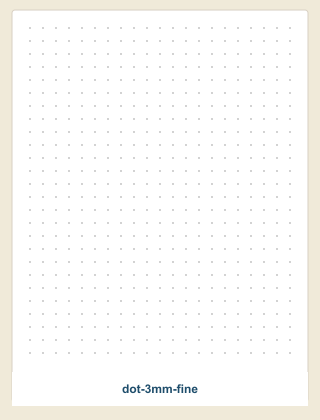
Dense 3mm dot grid on A4. Ideal for detailed technical sketches and precise freehand drawing.
Dot grid paper — also called dotted grid paper, or simply dot paper — is a sheet marked with a regular matrix of small dots instead of solid lines. Each dot sits at the corner where graph-paper lines would normally cross, so dot grid paper gives you the same alignment —straight rows, even columns, tidy boxes — while leaving the page looking almost blank. Once you start writing, the dots recede into the background rather than fighting your handwriting, which is exactly why bullet journalers, sketchers, and note-takers reach for it over lined or graph paper. For 3D sketching, its triangular cousin is isometric dot paper — the same dots-only idea arranged on a 30° lattice — or isometric graph paper if you prefer full printed lines.
The trick to writing on dot grid paper is to treat the dots as invisible baselines. Rest your letters on an imaginary line running through a row of dots, and use the next row up as the height guide —your text stays level without a printed rule under it. For headings, skip a row; for straight underlines or tables, connect two dots with a ruler.
Treat the dots as anchor points. To rule a line, join two dots with a straight edge; to build a weekly spread, count dots to size equal columns; to box a habit tracker, hop the same number of dots across and down. Because nothing is pre-printed, one sheet of dot grid paper becomes an index, a monthly calendar, a task list, or a mood tracker —you decide the layout instead of the page deciding it for you.
Keep a light grey dot colour and a small dot size for finished work — the dots guide your pen but barely show in a photo. Switch to a darker dot only when you need the grid to read clearly, such as for diagrams or teaching handouts.
Every sheet exports as a vector file, so a dot grid paper A4 PDF prints as crisply as 8.5 × 11 US Letter. A5 is the favourite for bullet journals and disc-bound planners, while A3 and Tabloid suit large mind maps. Print loose-leaf sheets for a ring binder, or run off A5 or Letter and trim to fit a Happy Planner or Filofax — the dots stay round and even at any print resolution because nothing is rasterised.
Spacing sets the feel of the page: 5 mm is the everyday bullet-journal standard, 7 mm gives roomy layouts for larger handwriting, 3 mm packs in fine detail, and ¼ inch (6.35 mm) matches imperial notebooks. Smaller spacing means more dots and more precision, at the cost of a busier sheet.
Pick a dot size from small to large and a colour from light grey to black or blue. Light grey, small dots are ideal for lettering and finished spreads; darker dots help when the grid itself needs to be visible.
| Paper | Structure | Best for |
|---|---|---|
| Dot grid | Faint dots —subtle guidance in every direction. | Bullet journals, planners, mixed writing and drawing. |
| Lined | Full horizontal rules —one direction only. | Pure prose, letters, essays, standard note-taking. |
| Graph | Full grid —strong visible squares. | Maths, technical drawing, precise plotting. |
| Blank | No guidance at all. | Free sketching, when any structure feels limiting. |
Dot grid paper is the most flexible of the four: it guides both writing and drawing without boxing you in the way lined or graph paper can, which is why it has become the default for modern journaling.
You can buy a dot grid paper notebook such as a Leuchtturm1917, Rhodia, or Moleskine from Amazon, Staples, or a local stationery shop, and a search for “dot grid paper near me” usually turns up a store nearby. The trade-off is a fixed dot spacing, size, and colour you cannot change.
Printing your own free dot grid paper lets you set the exact spacing and page size, test a layout before committing it to your notebook, and reprint whenever you run out — no shipping and no cost. That is what the generator at the top of this page is for.
Bullet journals, planners, note-taking, sketching, hand-lettering, and simple diagrams. The faint dots give alignment for straight lines, boxes, and charts, then disappear into the background once you write —so the page never looks as busy as full graph paper.
5 mm is the standard, matching notebooks like Leuchtturm1917 and Rhodia. It fits normal handwriting and neat weekly grids. Go 7 mm for larger writing and open layouts, or 3 mm for dense planning and small script.
It depends on the task. Dot grid is the most flexible —it guides both writing and drawing without boxing you in. Lined paper is best for pure prose, graph paper for precise technical work. Dot grid sits in between, which is why most journalers prefer it.
In the print dialog choose “Actual Size” or “100% scale” rather than “Fit to Page,” so 5 mm dots stay exactly 5 mm apart. The PDF is vector, so dots stay crisp at any size, and A5 output slots neatly into a pocket notebook.
You can, by inserting a table or a repeating dot pattern, but it is fiddly to get the spacing exact and to keep the dots faint. Downloading a ready-made dot grid paper PDF here is faster, prints at a precise 5 mm, and drops straight into any binder or notebook.