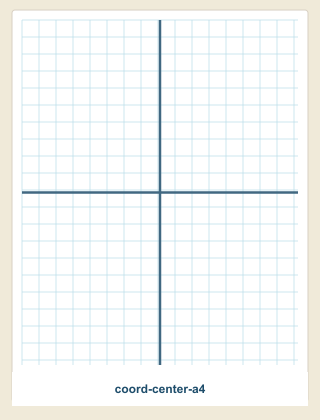
Centered Axes — A4
Standard Cartesian coordinate grid with axes at center. 5mm grid with major lines every 5 cells. The go-to paper for graphing equations.
Coordinate plane graph paper is grid paper with numbered X and Y axes for plotting points and graphing equations. This free printable coordinate plane graph paper generator lets you switch the axis numbers on or off, choose four quadrants or Quadrant I, set the grid size and colours, preview it live, and download a coordinate plane graph paper PDF for Letter or A4 — no signup and no watermark.
✓ Real-time preview — every change updates instantly.
For true-size units, choose “Actual Size” (not “Fit to Page”) in your printer dialog.
One-click download of ready-made coordinate plane graph paper — or open any layout in the generator above to tweak it.
Standard Cartesian coordinate grid with axes at center. 5mm grid with major lines every 5 cells. The go-to paper for graphing equations.
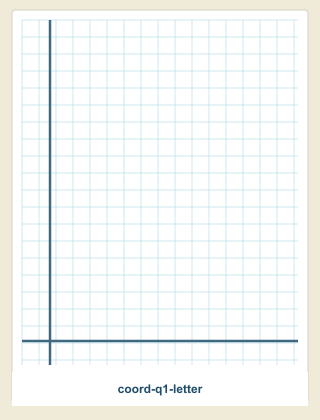
Axes at bottom-left showing only Quadrant I (positive X and Y). Ideal for data plots, bar charts, and positive-domain functions.
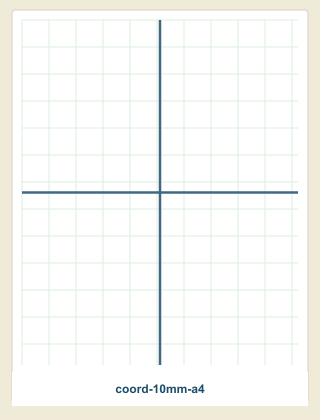
Big 10mm grid with centered axes. Easy to read and write on, perfect for younger students learning to plot points.
Set the grid spacing to 3 mm, 5 mm, 10 mm, or ¼ inch. Choose centered axes for four-quadrant coordinate graph paper or move the origin to the bottom-left for a Quadrant I worksheet. Axis numbers can be shown or hidden.
For a larger coordinate plane, start with the 10 mm grid; for finer plotting, choose 3 mm or 5 mm spacing. The major grid can be turned off or emphasized every 5 or 10 cells. Open the Quadrant I template or preview the large 10 mm coordinate grid.
Coordinate plane graph paper — also called Cartesian plane or coordinate grid paper — is grid paper with a horizontal X axis and a vertical Y axis that cross at the origin, dividing the sheet into four quadrants. Each point is located by an (x, y) pair, so coordinate plane graph paper is the standard sheet for plotting points, graphing equations, and drawing functions in maths class. This generator adds arrowed axes, evenly spaced tick marks, and optional numbered gridlines, then exports a crisp vector PDF.
Switch Axis Numbers on to label the X and Y axes automatically —instant coordinate plane graph paper with numbers, ready to plot on. Prefer a clean sheet for a test or worksheet? Turn the numbers off and students fill in their own scale. The major gridlines set where the numbers fall, so every fifth or tenth line is labelled.
Choose Center to place the origin in the middle, giving a full four-quadrant plane with positive and negative axes — the go-to for graphing equations. Choose Bottom-Left for a Quadrant I grid with only positive X and Y, which suits data plots, bar charts, and beginners.
Every sheet is a vector file, so a coordinate plane graph paper PDF prints as sharply on A4 as on 8.5 × 11 US Letter. Use A5 for a quick worksheet or A3 for a large classroom graph. Nothing is rasterised, so the axes and numbers stay crisp at any size.
The range depends on grid spacing: a larger 10 mm grid on Letter or A4 gives roughly a 10×10 to 20×20 coordinate plane, while a fine 5 mm grid fits a wider range on one page. Turn on the numbers, pick the spacing that shows the range you need, and print at Actual Size so each unit is exact.
Spacing runs from 3 mm to 10 mm (plus ¼ inch), with major gridlines every 5 or 10 cells. Set a light blue, grey, or green grid and a dark, black, or navy axis so your coordinate plane graph paper stays easy to read.
To plot a point (x, y), start at the origin, move x units along the horizontal axis —right for positive, left for negative — then y units vertically, up for positive and down for negative, and mark where you land. The numbered axes make each step easy to count. Because this is blank coordinate plane graph paper rather than a fixed worksheet, it works for any plotting-points practice, graphing activity, or homework set: print a stack and reuse the same clean grid for every exercise. Because it is free printable coordinate plane graph paper, you can keep a whole term's worth ready without buying anything.
This is a two-dimensional x/y coordinate plane. If you are looking for an xyz coordinate system to sketch in three dimensions, a flat grid can't show depth — the usual choice is isometric graph paper, whose 30° triangular grid gives you three axes for 3D drawing. For all standard algebra and geometry graphing, the 2D coordinate plane graph paper on this page is what you want.
Grid paper with a horizontal X axis and vertical Y axis crossing at the origin, dividing the sheet into four quadrants. It is used to plot points, graph equations, and draw functions. This generator adds arrowed axes, tick marks, and numbered gridlines.
Yes —turn on Axis Numbers to label the X and Y axes automatically, giving coordinate plane graph paper with numbers ready to plot on. You can also switch the numbers off for a clean grid where students fill in their own scale.
Four-quadrant paper puts the origin in the centre, so both axes run positive and negative — the standard for graphing equations. Quadrant I paper puts the origin at the bottom-left, showing only positive X and Y, which suits data plots and younger students.
Yes. Turn on the numbered axes and pick the grid spacing to set the range: a larger 10 mm grid on Letter or A4 gives roughly a 10x10 to 20x20 coordinate plane, while a smaller grid fits a wider range. Print at Actual Size so each unit stays exact.