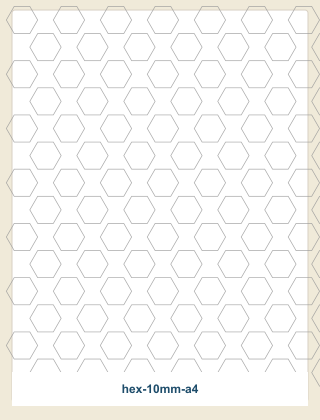
10mm Hexagonal Grid — A4
10mm side hexagons on A4 with gray lines. Standard size for organic chemistry structures and hex-based board game maps.
Hexagonal graph paper tiles the page with a honeycomb of six-sided cells whose corners meet at 120° — the same angle as the bonds in a benzene ring. That makes this free printable hexagonal graph paper generator equally at home in organic chemistry and on the tabletop. Set the hexagon size, colour, and line weight, preview it live, and download a hexagonal graph paper PDF at A4, Letter, or A3 — no signup and no watermark.
✓ Real-time preview — every change updates instantly.
For true-size hexagons, choose “Actual Size” (not “Fit to Page”) in your printer dialog.
One-click download of ready-made hexagonal graph paper — or open any template in the generator above to tweak it.
10mm side hexagons on A4 with gray lines. Standard size for organic chemistry structures and hex-based board game maps.
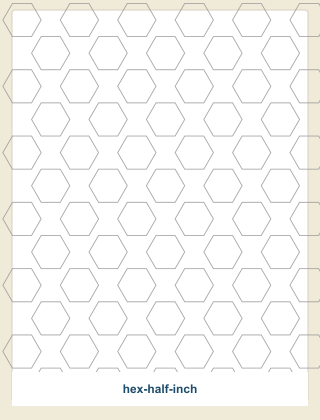
Half-inch hexagons on Letter paper. Perfect for tabletop RPG battle maps, wargaming, and strategy game prototyping.
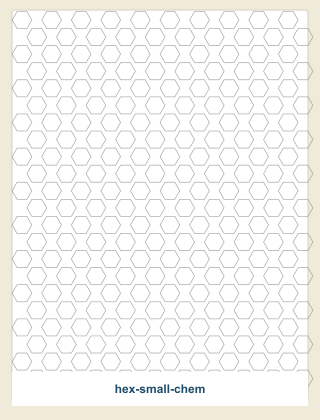
Small 5mm hexagons on A4. Compact size ideal for drawing organic chemistry molecular structures and benzene rings.
Hexagonal graph paper — also called hexagon graph paper or simply hex paper — is a sheet tiled with a honeycomb of regular six-sided cells. Three hexagons meet at every corner at 120°, the same angle found in a benzene ring, which is exactly why hexagonal graph paper is the standard sheet for chemistry as well as for tabletop games. This generator draws flat-top hexagons and lets you set the hexagon size, line colour, and weight before exporting a crisp vector PDF, so the honeycomb stays even at any print resolution.
The six-membered ring is everywhere in organic chemistry —benzene, cyclohexane, pyridine, glucose —and each one maps onto a single hexagon. Rest a ring on the grid and every bond lands at the correct 120° angle automatically, so structures stay neat and to scale. Fused systems like naphthalene or the steroid skeleton share edges between adjacent hexagons, which the honeycomb makes trivial to line up. Printable hexagonal graph paper for organic chemistry beats freehand hexagons every time.
A 5 mm hexagon suits compact structural formulas and problem sets; 7 mm gives a little more room for substituent labels. Many students keep an organic chemistry hexagon paper notebook of printed sheets for homework and exam practice.
Hex grids are the backbone of tabletop gaming. Role-playing battle maps use them so a figure moves the same distance in six directions instead of four; classic hex-and-counter wargames measure movement and firing range in hexes; and board-game designers prototype tile layouts on them before cutting any pieces. A ½-inch or larger hexagon leaves room for a miniature or a hand-written label inside each cell. Print hexagonal graph paper on A3 or Tabloid when you need a full battle map in one sheet.
Every sheet is a vector file, so a hexagonal graph paper A4 PDF prints as sharply as 8.5 × 11 US Letter. Use A5 for a pocket chemistry notebook, or A3 and Tabloid for large game maps. Nothing is rasterised, so the cells stay even at any resolution.
Hexagon size is measured along one side: 5 mm for chemistry and dense work, 10 mm as the everyday default, and ½ inch (12.7 mm) or 15 mm for game maps. Smaller hexagons pack more cells onto the page at the cost of a busier sheet.
Prefer to work on a tablet? Save the file and open it as digital hexagonal graph paper in any notes app that imports PDFs, then draw structures or maps on top with a stylus.
You can buy a hexagonal graph paper notebook or pad from Amazon or Officeworks, and a search for “hexagonal graph paper near me” usually turns up a store nearby; free web tools such as the well-known Incompetech generator are another route. The trade-off with a printed pad is a fixed hexagon size and colour you cannot change.
Printing your own free hexagon graph paper lets you set the exact hexagon size and page format, switch between chemistry and game layouts in seconds, and reprint whenever you run out — no cost. That is what the generator at the top of this page is for.
Mainly organic chemistry —drawing benzene rings and other six-membered ring structures —and tabletop gaming, where hex grids power RPG battle maps, wargames, and board-game design. It also suits tiling patterns, quilting, and any layout built on a honeycomb.
Because the corners of a regular hexagon meet at 120°, exactly the bond angle in a benzene ring and most saturated six-membered rings. Resting a ring on the grid puts every bond at the right angle, and fused ring systems share edges between neighbouring hexagons, so complex structures stay neat and to scale.
Size is measured along one side of the hexagon. Use 5 mm for compact organic chemistry structures, 10 mm as an all-round default, and ½ inch (12.7 mm) or 15 mm for game maps that need to hold a miniature or a label inside each cell.
In the print dialog choose “Actual Size” or “100% scale” rather than “Fit to Page,” so a 10 mm hexagon stays exactly 10 mm. The PDF is vector, so cells print crisp from A5 chemistry notebooks up to A3 and Tabloid battle maps.